


Lot SM-041
Société Française d’Orfèvrerie d’Art – Profit-Sharing Certificate, No. 001879 (1920)
Specifications:
Location:
France, Paris
Age:
20 December 1920
Frame size:
43 x 33.5 cm
Material:
Wooden frame | Paper | Glass
Available in Dubai
7 000,00 AED

Lot Essay
Delivery
Description
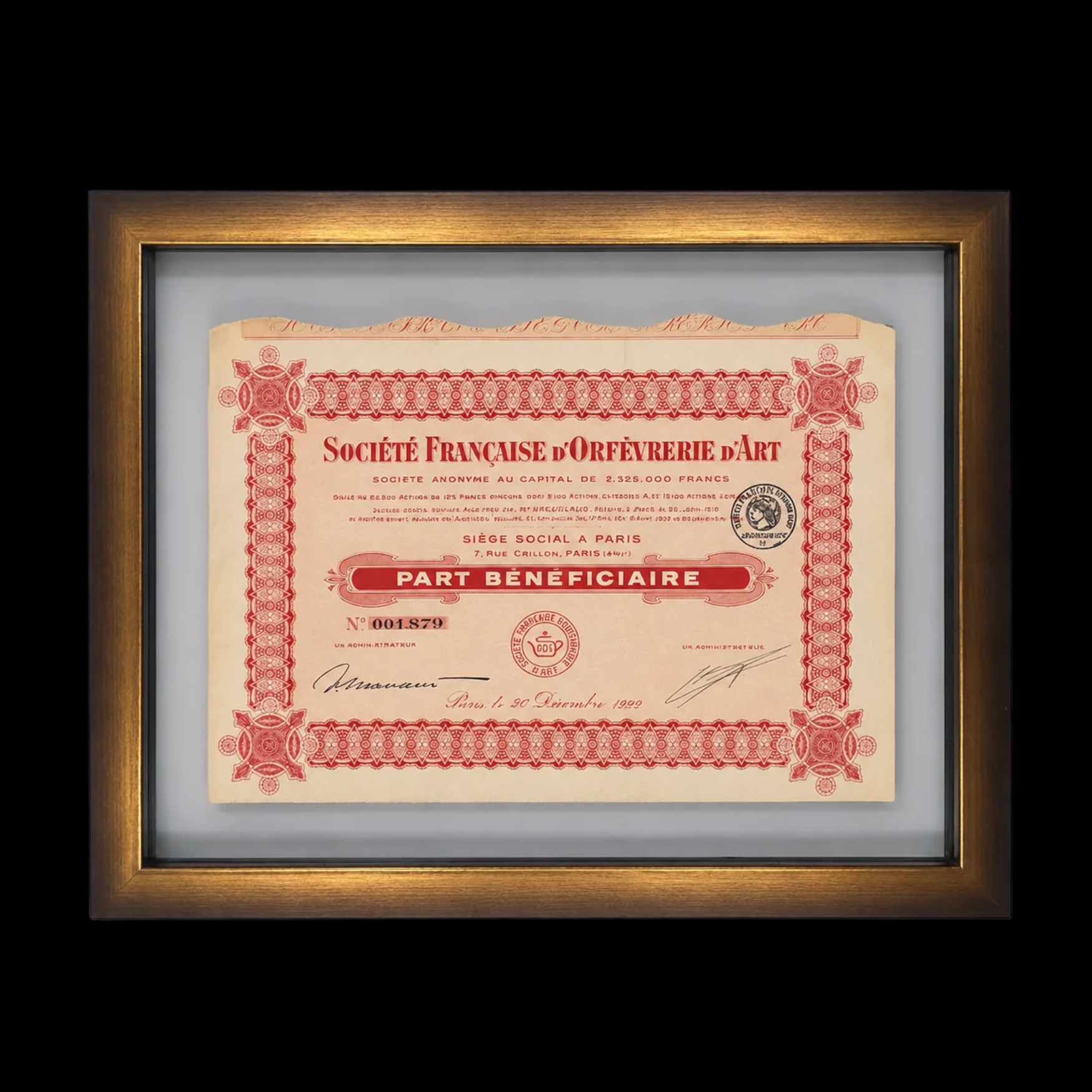
An original French profit-sharing certificate (Part Bénéficiaire) issued on 20 December 1920 by Société Française d’Orfèvrerie d’Art, a Paris-based company associated with the production of decorative metalwork and silverware.
The certificate bears the individual number 001879 and was issued under the company’s financial structure, which included a stated share capital of 2,525,000 French francs, divided into 20,200 shares of 125 francs each.
Unlike an ordinary share certificate, this document represents a part bénéficiaire — a special financial instrument designed to provide participation in company profits according to the rights established in its statutes. Such certificates did not necessarily confer the same ownership or voting rights as ordinary shares.
The document features an elegant red and cream colour scheme, elaborate geometric borders, ornamental corner medallions, and refined French typography. Its composition reflects the decorative traditions of French financial printing in the early twentieth century.
The certificate bears the company’s circular stamp and the signatures of two administrators. Its registered office is identified as 7 Rue Crillon, Paris (4th arrondissement).
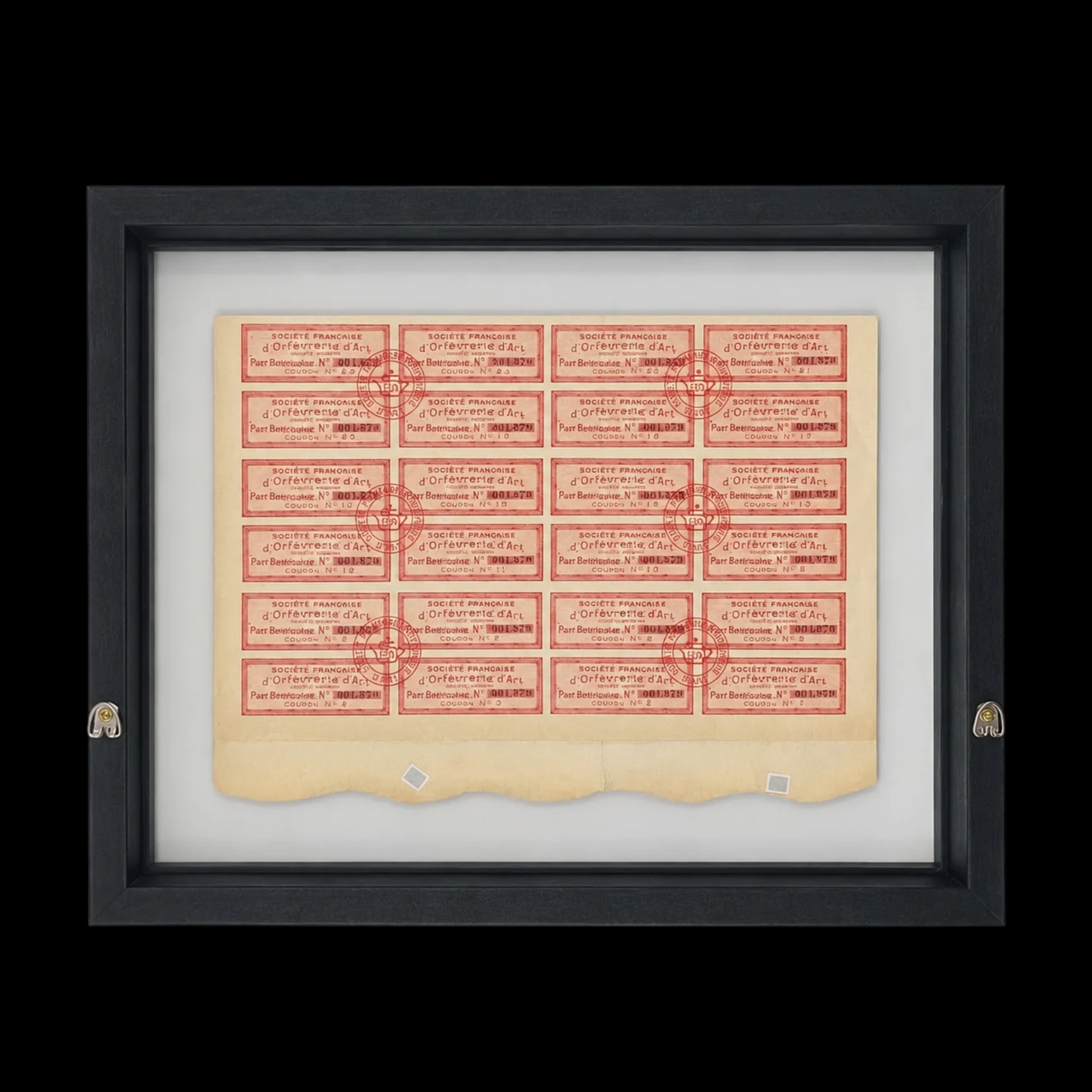
The reverse retains a sheet of numbered coupons bearing company stamps, illustrating the original mechanism through which financial distributions could be administered.
Presented in a bronze-toned frame, the certificate combines the sophistication of historical French typography with the artistic heritage of the decorative arts industry.
Rarity and Value
This certificate belongs to the specialised field of scripophily, the collection of historical financial instruments valued for their artistic craftsmanship, economic significance, and cultural associations.
Its particular interest lies in its connection to the French decorative arts industry and its unusual classification as a profit-sharing certificate rather than an ordinary share or bond.
The part bénéficiaire was a distinctive feature of certain French corporate financing arrangements, allowing companies to allocate defined rights to profits without necessarily issuing additional ordinary share capital.
The document’s ornamental red printing, individual serial number, official company stamps, and surviving coupons contribute to its collectible character.
Unlike securities representing major railway, banking, or industrial corporations, this certificate illustrates the financial organisation of a company operating within the specialised world of French artistic metalwork.
Its historical appeal is further enhanced by its association with the period immediately following the First World War, when French manufacturing and decorative arts businesses were adapting to a changing economic environment.
The rarity of this particular issue has not been independently established. Its collectible value today depends on historical interest, condition, completeness, and provenance rather than any presumed continuing financial entitlement.
Discovery & Historical Background
The certificate was issued in Paris on 20 December 1920, during an important transitional period in French industrial and artistic history.
The early twentieth century was a significant era for French decorative metalwork. Traditional silversmithing techniques coexisted with increasingly industrialised manufacturing methods, allowing workshops and larger enterprises to produce objects for both private interiors and the dining table.
French orfèvrerie, or silversmithing, encompassed a wide range of objects, including tableware, serving pieces, decorative accessories, and luxury household furnishings.
Société Française d’Orfèvrerie d’Art was active within this tradition. The company is also associated with the name ARGIT, which appears in historical and modern auction descriptions of French silver-plated tableware.
Surviving objects attributed to the company include decorative cutlery and serving pieces, often featuring classical motifs such as laurel leaves, ribbon ornamentation, and floral designs.
The company’s products demonstrate the continued popularity of traditional French decorative styles during the early decades of the twentieth century.
The certificate itself provides valuable evidence of the company’s corporate organisation. It records a substantial stated share capital and identifies a formal registered office in central Paris.
Its issue in December 1920 places it at the beginning of a decade that would become closely associated with the development of Art Deco, a movement that brought renewed international attention to French craftsmanship, design, and luxury manufacturing.
Although the certificate does not establish that the company participated directly in the Art Deco movement, it belongs to the broader commercial and artistic environment from which many celebrated French decorative objects emerged.
Human Touch
Behind the delicate red engraving of this certificate lies a story of French craftsmanship, artistic tradition, and the people who contributed to the production of everyday objects of beauty.
In the early twentieth century, French decorative metalwork required a combination of technical knowledge and artistic sensitivity. Designers created patterns and ornamental compositions, while skilled metalworkers transformed those designs into functional and decorative objects.
A single piece of fine tableware could involve several specialised processes, including forming, casting, engraving, polishing, and plating.
The company represented by this certificate belonged to an industry in which traditional craftsmanship met the commercial structures of modern manufacturing.
The certificate itself reflects a similar relationship between art and industry. Its elaborate borders and carefully balanced typography demonstrate that even financial documents were designed with attention to visual harmony.
The surviving coupons are especially evocative. Before electronic financial systems, participation in company distributions could depend on the presentation of small detachable paper coupons, each linked to the original certificate.
The handwritten signatures and official stamps provide another tangible connection to the people responsible for administering the enterprise.
More than a century later, this document survives as an elegant reminder of the financial structures that supported French decorative arts businesses.
Preserved within its frame, it connects the history of craftsmanship, industrial enterprise, and the refined visual culture of early twentieth-century Paris.
Delivery
Brought to you by

Need more details?
Lot SM-030
Giorgio Armani Signed Photograph

Lot SM-035
10 000,00 AEDRussian Tobacco Company – Imperial Share Warrant, 25 Shares, No. D2643 (1915)
Lot SM-026
Coco Chanel Dress with Signed Original Label, 1921

Lot SM-023
Another Kingdom Backgammon Set by Taras Yoom, Yoomoota Art Universe
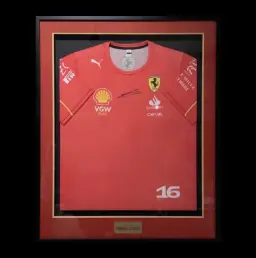
Lot SM-029
Charles Leclerc Signed Scuderia Ferrari T-Shirt
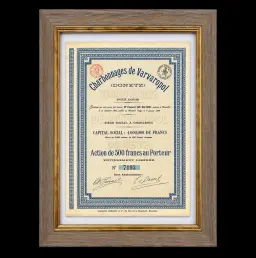
Lot SM-038
7 000,00 AEDCharbonnages de Varvaropol (Donetz) – 500 Francs Bearer Share, No. 7193, c.1896
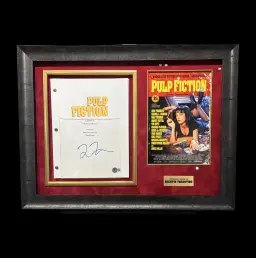
Lot SM-008
Quentin Tarantino Signed Pulp Fiction Film Script
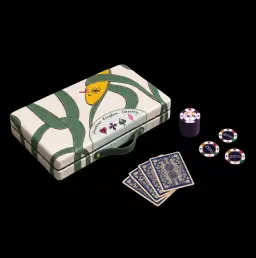
Lot SM-034
Another Kingdom: Destiny Poker Set by Taras Zheltyshev, Yoomoota Art Universe
Lot SM-032
Elton John Vest from the Artist’s Personal Wardrobe
Lot SM-025
World Map (YRM) Rug by Taras Yoom, Yoomoota Art Universe
Lot SM-041
Item has been added to your Cart
You cannot add "Société Française d’Orfèvrerie d’Art – Profit-Sharing Certificate, No. 001879 (1920)" to your cart again.
Enquiry
Lot SM-041
Thank you for your interest. Please fill out the below form, and our specialist will follow up with you shortly.
Thank you for your interest
We will be in touch shortly
We will never pass your personal information to anyone outside of Artefactum Gallery for their own marketing purposes without your consent. For more information about how we processes your data, please click here to read our Privacy Notice.
Brought to you by

Enquiry
Thank you for your interest. Please fill out the below form, and our specialist will follow up with you shortly.
Thank you for your interest
We will be in touch shortly
We will never pass your personal information to anyone outside of Artefactum Gallery for their own marketing purposes without your consent. For more information about how we processes your data, please click here to read our Privacy Notice.