


Lot SM-043
Chinese Imperial Government – £50 Gold Loan Bond, Series B, No. 75498 (1896)
Specifications:
Location:
Germany, Berlin
Age:
1 April 1896
Frame size:
68.5 x 55.5 cm
Material:
Wooden frame | Paper | Glass
Available in Dubai
10 000,00 AED

Lot Essay
Delivery
Description
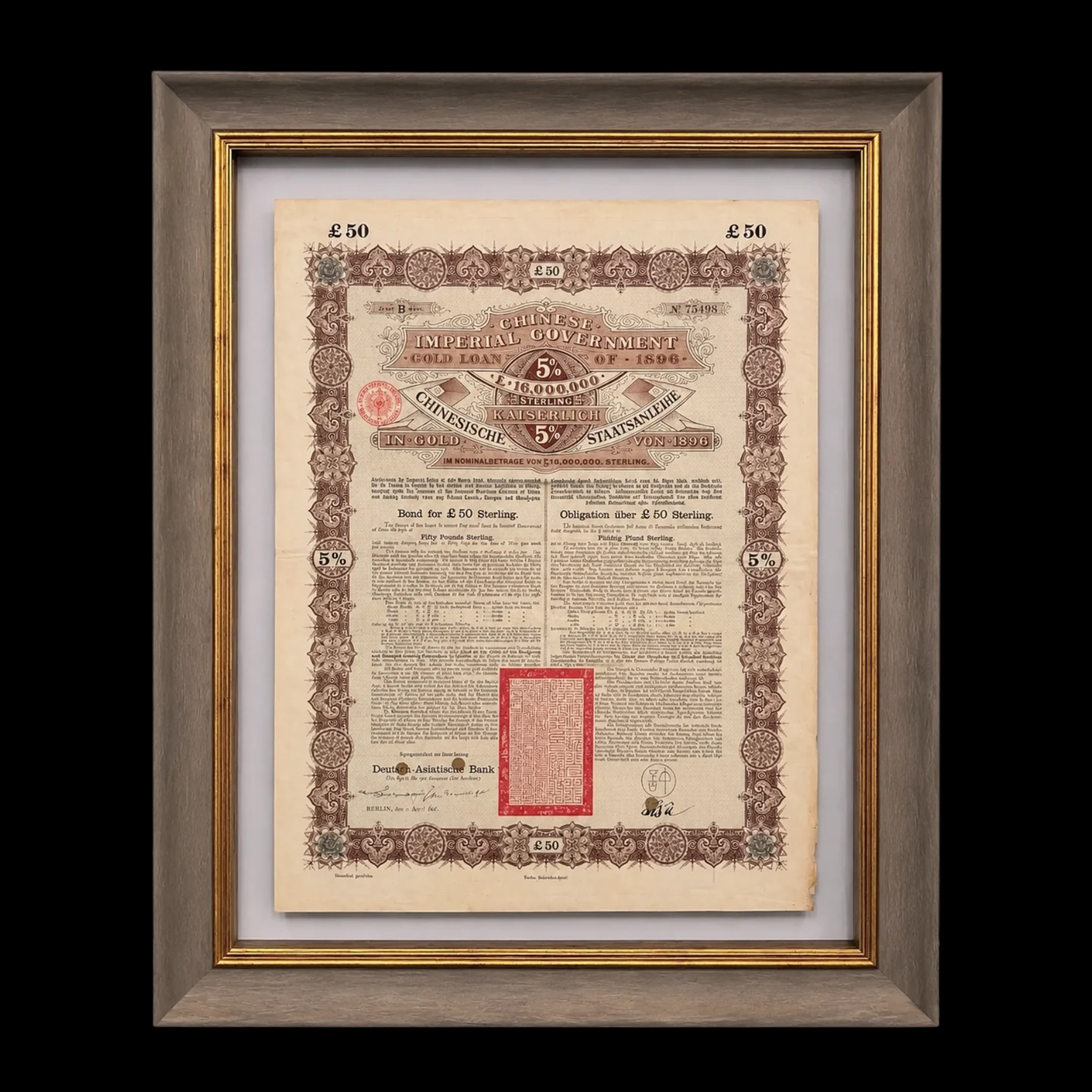
An original antique 5% Gold Loan Bond issued on 1 April 1896 on behalf of the Chinese Imperial Government, during the reign of the Qing dynasty, China’s last imperial dynasty.
The certificate represents a government bond with a nominal value of £50 sterling, belonging to Series B, No. 75498, and forming part of an international loan of £16,000,000.
Issued in Berlin through the Deutsch-Asiatische Bank (German-Asiatic Bank), the bond represents a remarkable example of nineteenth-century financial cooperation between Imperial China and European banking institutions.
The certificate features an elaborate brown and black engraved design with ornamental borders, intricate geometric patterns, and decorative motifs influenced by both European security printing and Chinese visual traditions.
The inscriptions appear in English and German, reflecting the international character of the loan. The document also incorporates an official red seal, signatures, and detailed financial provisions.
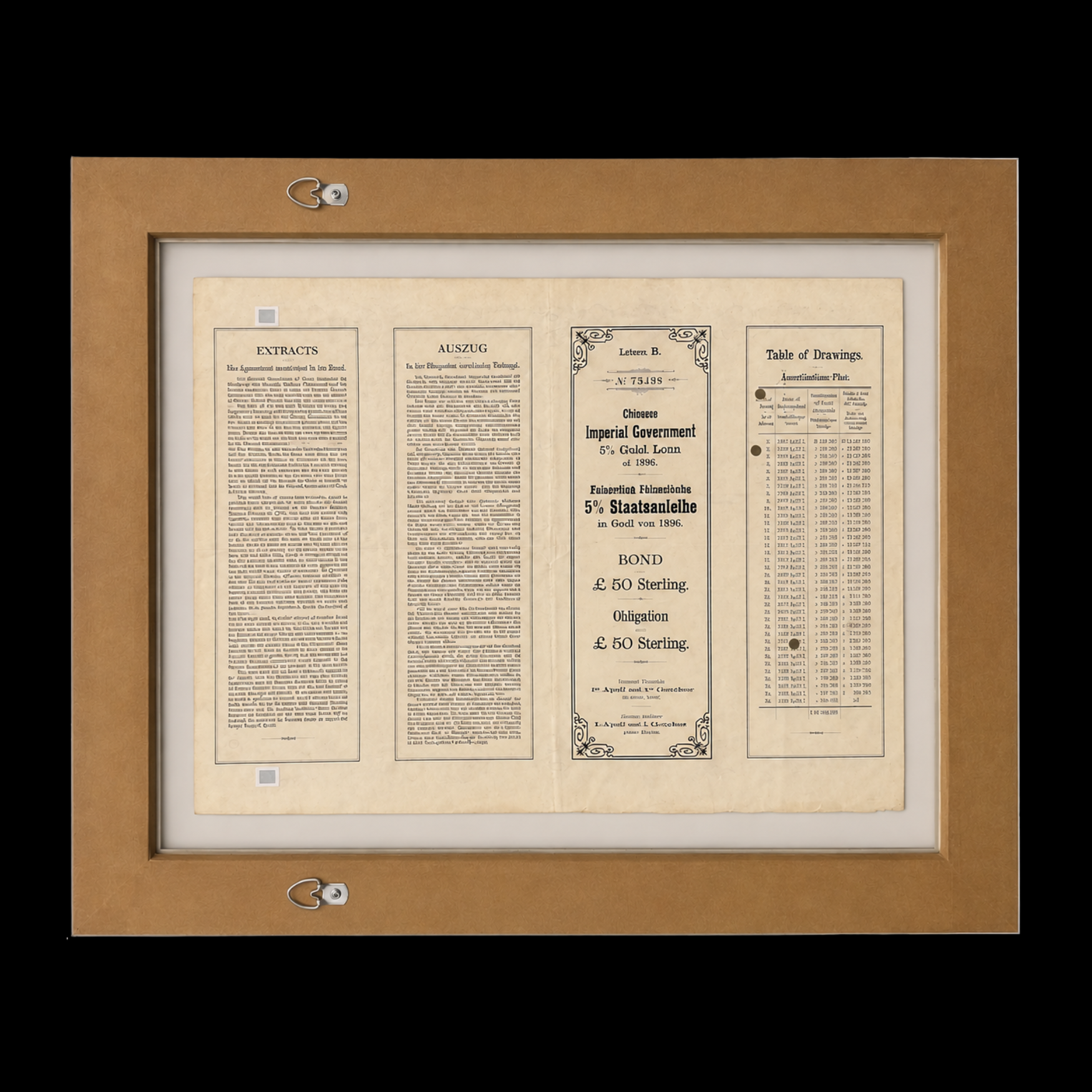
The reverse contains extracts from the bond agreement, together with a table of drawings outlining the scheduled amortisation of the loan.
The bond was printed by the Reichsdruckerei in Berlin, the German Imperial Printing Office, known for producing official documents and securities requiring sophisticated printing techniques.
Presented in a grey wood-effect frame with a gold-coloured inner border, the certificate combines the artistry of historical financial engraving with the political and economic history of Imperial China.
Rarity and Value
This certificate belongs to the specialised field of scripophily, the collecting of historical stocks, bonds, and financial instruments for their artistic, cultural, and economic significance.
Its particular interest lies in its association with the Qing dynasty, the international financing of the Chinese Empire, and the growing influence of European banking institutions in East Asia during the late nineteenth century.
The £50 denomination, individual certificate number, elaborate engraved borders, official markings, and bilingual inscriptions give the document a distinctive identity within the 1896 Gold Loan series.
The bond is especially notable for its connection to one of the major international financial arrangements concluded by China following the First Sino-Japanese War.
Surviving examples of the 1896 Chinese Imperial Government Gold Loan are documented in specialist scripophily collections and auction catalogues, with different denominations, including £25, £50, and £100.
Their collectible appeal depends on preservation, completeness, denomination, cancellation status, and historical interest.
Today, the certificate is appreciated primarily as an important historical and decorative document, representing the intersection of Chinese imperial history, European finance, and nineteenth-century security printing.
Discovery & Historical Background
The Chinese Imperial Government Gold Loan of 1896 was arranged during a critical period in China’s modern history.
Following China’s defeat in the First Sino-Japanese War of 1894–1895, the Qing government faced substantial financial obligations under the Treaty of Shimonoseki, including a large indemnity payable to Japan.
To meet these obligations, the Chinese government turned increasingly to international financial markets.
In 1896, an Anglo-German banking syndicate organised a major government loan of £16,000,000 sterling, carrying an annual interest rate of 5%.
The loan was arranged through two important financial institutions: the Hongkong and Shanghai Banking Corporation, based in London, and the Deutsch-Asiatische Bank, operating from Berlin.
The loan was secured principally through revenues associated with the Chinese Imperial Maritime Customs, an important source of government income derived from international trade.
This arrangement demonstrates the growing connection between sovereign borrowing, customs revenue, and international diplomacy in late Qing China.
The present certificate was issued in Berlin on 1 April 1896, during the reign of the Guangxu Emperor, who ruled from 1875 to 1908.
It belongs to a period when China was experiencing intense pressure from foreign powers while simultaneously attempting to modernise its institutions, infrastructure, and economy.
The 1896 loan formed part of a broader series of foreign borrowing arrangements that would influence China’s financial and diplomatic relationships for decades.
The Qing dynasty ultimately ended in 1912, following the Xinhai Revolution, making this document a surviving financial record of the final decades of imperial rule.
Human Touch
More than a century ago, this bond represented a financial connection between the imperial government in Beijing and investors thousands of kilometres away in Europe.
Behind its elaborate engraved borders lies a story of international diplomacy, economic uncertainty, and the enormous political transformations taking place at the end of the nineteenth century.
For a European investor in 1896, purchasing a Chinese government bond meant participating in the finances of one of the world’s oldest imperial states, at a time when international capital markets were becoming increasingly interconnected.
For the Qing government, such financial arrangements provided access to resources needed to meet urgent obligations following military defeat.
The document itself reflects the meeting of two distinct worlds. European printing techniques, formal financial language, and carefully structured repayment provisions were combined with references to Chinese imperial authority and official seals.
Its intricate design was intended to communicate legitimacy, reliability, and financial confidence.
The reverse, with its detailed terms and repayment schedule, reveals the practical mechanisms behind international sovereign lending before electronic finance and modern global banking systems.
Every signature, seal, and engraved detail recalls an era when government obligations circulated as physical certificates, representing promises that crossed borders and connected distant financial centres.
Today, this surviving bond offers a tangible connection to the final decades of the Qing dynasty and the emergence of a more interconnected international financial system.
It stands as an evocative historical artefact — a document in which the artistic craftsmanship of nineteenth-century Europe meets the complex political and economic history of Imperial China.
Delivery
Brought to you by

Need more details?

Lot SM-038
7 000,00 AEDCharbonnages de Varvaropol (Donetz) – 500 Francs Bearer Share, No. 7193, c.1896

Lot SM-027
Mike Tyson Signed Boxing Glove (Red)

Lot SM-001
Muhammad Ali Signed “God Is One” Brochure
Lot SM-024
Silver Stallion Sculpture by Taras Yoom, Yoomoota Art Universe
Lot SM-011
Vladimir Lenin Signed Handwritten Note
Lot SM-037
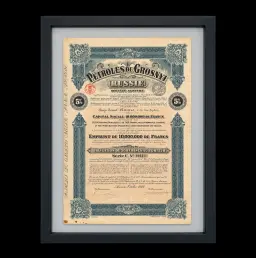
7 000,00 AEDPétroles de Grosnyi (Russie) – 5% Gold Bond, 500 Francs, Series C, 1919
Lot SM-032
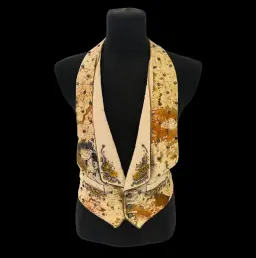
Elton John Vest from the Artist’s Personal Wardrobe
Lot SM-026
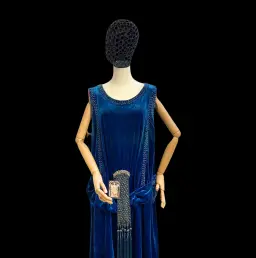
Coco Chanel Dress with Signed Original Label, 1921

Lot SM-021
Andrea Bocelli Signed Vinyl Record

Lot SM-017
Zaha Hadid Signed Photograph
Lot SM-043
Item has been added to your Cart
You cannot add "Chinese Imperial Government – £50 Gold Loan Bond, Series B, No. 75498 (1896)" to your cart again.
Enquiry
Lot SM-043
Thank you for your interest. Please fill out the below form, and our specialist will follow up with you shortly.
Thank you for your interest
We will be in touch shortly
We will never pass your personal information to anyone outside of Artefactum Gallery for their own marketing purposes without your consent. For more information about how we processes your data, please click here to read our Privacy Notice.
Brought to you by

Enquiry
Thank you for your interest. Please fill out the below form, and our specialist will follow up with you shortly.
Thank you for your interest
We will be in touch shortly
We will never pass your personal information to anyone outside of Artefactum Gallery for their own marketing purposes without your consent. For more information about how we processes your data, please click here to read our Privacy Notice.